

How to Pitch a Tent on Hard Ground? (Effective Methods)
Properly pitching a tent is a key issue for the safety of its users. However, you cannot always do it in a standard way – using the pegs, anchors, and guylines included with the tent. The type of ground can often stand in your way. On concrete or asphalt, you must reach for appropriate tent weights. Read on to learn how to secure a tent on hard ground.
As a rule, you set up the tent as usual, except that instead of stakes and anchors, you use various types of weights in their place. Which tent weights should you choose? Here are our suggestions.
Types of weights
The Inventini offer includes several types of weights that you can use for securing your tent. Below is a short description of their characteristics:
Cast iron weights – they weigh approximately 15 kg and are disc-shaped, designed to slide onto the leg of a frame tent. They can be stacked, and thanks to a system of tabs and recesses, they remain stable. Each weight has a handle for easy carrying. A special type of cast iron weight is the one attached to the leg of a Pascal tent. It features a special PVC cover that enables the attachment. Additionally, cast iron weights can also be placed inside the legs of Fan tents.


Another entire group of products are sandbag weights, which can come in virtually any weight and, furthermore, can feature custom printing. We can produce weights in your chosen color or with a custom-designed print.
15 kg sandbag weights – designed for frame tents, these are shaped like slender cylinders that fasten to the tent leg with Velcro. Each weight features a carrying handle. You can attach up to 4 of these weights to a single tent leg. If necessary, these weights can also be used to anchor the tent’s guylines.

30 kg sandbag weights – these also have a cylindrical shape, but are significantly lower. At the bottom of the weight, there is a webbing strap with an eyelet for attaching guylines, while the top features a practical handle. This type of weight is used for Pascal and Fan tents. If you need to attach the weight to the leg of the aforementioned tents, you will need an additional carabiner to connect the eyelets of the weight and the leg.

15l water weight – this is a slender, water-filled cylinder. You attach it to the tent in the same way as the 15 kg sandbag weight. Unlike sand weights, water weights can be filled directly at the event location.

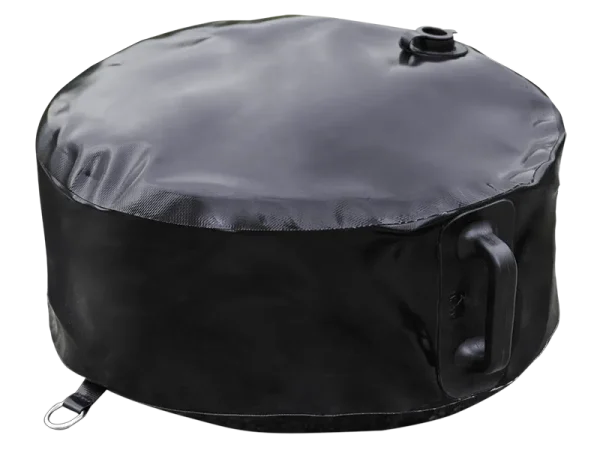
200l water weight – a large, cylindrical weight with a handle. It features a threaded opening at the top for filling with water and a second valve at the bottom for easy draining. It is best to fill 200l water weights only after they are positioned exactly at their final location – moving or carrying them afterwards is difficult and may cause damage. These large weights are dedicated to single-mast Startents.

70l water weight for Startent mast – this weight is designed to stabilize the mast of a standard star tent. The weight is cylindrical in shape, but the central part is hollow and not filled with water – resembling a donut.

Using weights
Each weight has been designed with a specific tent in mind. When purchasing your advertising tent, choose the appropriate weights in terms of both shape and weight.
Frame tents
Smaller 4-legged frame tents require one 15 kg weight per leg. For a larger 4-legged tent – 4x6m – it is better to secure it using eight 15 kg weights (two per leg).
6-legged tents should be anchored according to the rule: one 15 kg weight for each outer leg and two for each middle leg.
Startents
The process here is even simpler: for every tension strap, use one 200l weight, plus an additional 70L weight for the mast.
Fan and Pascal tents
When it comes to inflatable tents, the general rule is one 30 kg weight per leg and one 30 kg weight per guyline. As a result, you usually need eight 30 kg weights. The exception is the small Pascal 3×3 tent, where placing 4 weights on the guylines is sufficient.
However, the largest Pascal and Fan tents require slightly more ballast than the standard setup. Due to its height, the Pascal 6×6 tent has as many as 8 guylines – two on each leg – and each must be secured with 30 kg weights. An analogous situation applies to Fan 6×6 and 8×8 tents. Naturally, large Fan and Pascal tents also require one 30 kg weight for each leg.
Modular tents
Modular tents require one 30 kg weight per leg and one weight for each line. How to calculate how many weights you will need? It’s simple: multiply the number of tent ribs by 4.
Want to know how to maintain your event products? Check out our post: How to use a frame tent to enjoy it for years to come




See also:
 Modern Event Arches: 5 Hot Event Trends You Need to KnowInflatable gates are, one might say, an absolute classic. No race, marathon, or runni...
 From prototype to standard – production of an advertising billboardThere are products that grow directly from customer needs and evolve right alongside ...
 Custom Branded Promotional Furniture – Types and FunctionsWho said that furniture should only serve a practical purpose? As it turns out, it ca...
 What to Look for When Choosing a Funeral Tent?A funeral ceremony is a moment where everything must proceed in an atmosphere of sole...